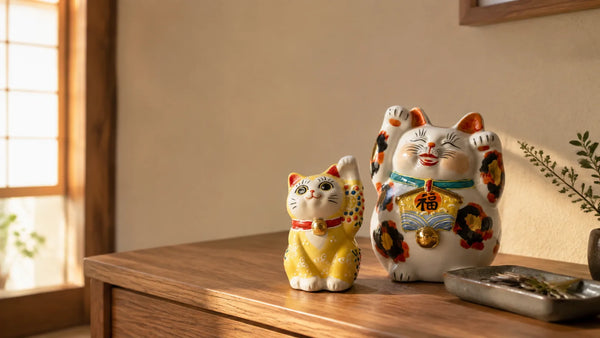
Cover scene: AI-assisted arrangement of the three Kutani daruma designs ZenKiln stocks, based on product photographs. Check the individual product pages for the actual pieces and dimensions.
A daruma is a rounded figure representing Bodhidharma, the Buddhist monk associated with the origins of Zen. The familiar papier-mâché type has a weighted base that lets it rock upright after tipping. Ceramic daruma can share the rounded outline without that mechanism. This guide explains the eye-filling custom and shows the construction of one of our porcelain figures.
Who Daruma was
Daruma is the Japanese name for Bodhidharma, an Indian monk credited with transmitting Zen Buddhist teachings to China in the 500s and revered as the first patriarch of Zen. Japanese painters have depicted him for centuries, and the visual conventions are consistent: an intense frontal gaze, heavy brows, unkempt beard. A hanging scroll by Kano Sanraku in the collection of The Metropolitan Museum of Art shows him seated, staring directly out at the viewer, biting his lower lip.
The doll compresses that painting tradition into a shape you can hold. There are no arms and no legs, which popular tradition attributes to the years he is said to have spent seated in meditation. The face keeps the eyebrows and the beard. Everything else becomes a smooth, rounded shell.
Why it is round, and why that matters
In the traditional papier-mâché type described by Gunma’s tourism guide, weight sits low in the shell so that the figure rocks upright after tipping. This gives a physical form to nanakorobi yaoki (七転び八起き), “fall down seven times, get up eight.” That construction should not be assumed for a ceramic figure.
The association with perseverance makes a daruma a possible reminder of a goal. The wish and the physical construction are separate: a porcelain display figure can carry the association without being a roly-poly toy.
The two eyes: what they are for
Many papier-mâché daruma are sold with blank eyes for the owner to fill in as part of a goal-setting custom.
You set a goal and paint in one eye. When you reach the goal, you paint in the second. A daruma with one eye is a commitment in progress; a daruma with two is a finished one.
Gunma Prefecture’s guide describes filling the figure’s left eye when making a wish and the other after reaching the goal. The doll’s left is on your right as you face it. Choose a figure intended for eye painting and follow its accompanying instructions.
The eye order and retirement customs vary by region, temple and household. Follow the practice that accompanies your figure.

Takasaki, and where the custom is anchored
Most daruma in Japan come from one city. According to the Gunma Official Tourist Guide, around 80 percent of Japan's daruma are made in Takasaki, Gunma Prefecture, and the tradition is tied to Shorinzan Darumaji temple. One account holds that roughly 200 years ago, following a famine, a temple monk created a mold for the papier-mache figures so local farmers could make and sell them at festivals.
The same guide records two details worth knowing when you look at a traditional daruma's face. The eyebrows are shaped as cranes and the beard as turtles, both long-life motifs. Once you have seen it you cannot unsee it.
The calendar matters too. The Shorinzan Nanakusa Taisai Daruma Market runs on January 6 and 7, which is why so many people associate buying a daruma with the opening days of the year. In Takasaki and at some other regional markets, old daruma are brought back for ritual burning—a customary way to retire them rather than discard them. Practices vary by place.
Papier-mache or porcelain: two different objects
Material changes both how a daruma is used and how it is handled.
Papier-mache daruma, including the familiar Takasaki type, are lightweight, hand-painted figures, usually red and sold with blank eyes. They are commonly used in a goal-setting custom: the owner fills one eye when setting a goal and the other when it is achieved. Depending on local practice, a figure may later be returned to a temple or daruma market for ritual burning; it is more accurate to describe this as a traditional retirement custom than as being “consumable.”
Porcelain daruma are a different proposition. They are decorative figures made by ceramic kilns and decorated with ceramic techniques such as overglaze enamel; they generally arrive with the face complete. Unlike papier-mâché daruma used in a goal-setting custom, they are usually kept and displayed rather than returned for ritual burning.

| Papier-mache daruma | Kutani porcelain daruma | |
|---|---|---|
| Eyes on arrival | Both blank, for you to fill in | Face already painted |
| What it is for | Setting a goal and tracking it | Display, and giving as a keepsake |
| After the goal | May be returned to a temple or daruma market for ritual burning; local practice varies | Kept |
| Mainly made in | Takasaki, Gunma Prefecture | Kutani kilns, Ishikawa Prefecture |
| Typical material | Paper over a mold, hand-painted | Porcelain, overglaze enamel, often gilded |
The daruma ZenKiln stocks are Kutani ware from Ishikawa Prefecture. Kutani porcelain is decorated in overglaze enamel, painted onto an already-glazed surface and fired again at a lower temperature, which is what allows the palette the craft is known for: the Association for the Promotion of Traditional Craft Industries gives the Kutani gosai five colors as red, yellow, green, purple and Prussian blue, and dates the beginning of the ware to 1655.
Our Kutani daruma are supplied with both eyes already painted. If you want to perform the eye-filling custom, choose a figure specifically sold for it. Keep the finished porcelain surface as supplied.
What the actual porcelain base shows
Our blue Hanazume daruma has two painted pupils and a white face framed by gold-coloured lines. Turn to the underside photograph and you can see a flat circular standing area around an open hole, with a red mark beside it. The product record does not specify a weighted rocking mechanism. Treat it as a ceramic display piece; do not tip it to test the proverb.


What we stock
- A blue hanazume daruma by Taishi Kiln, 5.2 cm high, with a dense floral pattern in the five Kutani colors over a pale blue ground and gold-tone outlines around the white face.
- A green cherry-blossom daruma, also from Taishi Kiln, the same size and form, with pink sakura and gold-tone outlines wrapping the body.
- A third, decorated in pine, bamboo and plum, the sanyu-mon grouping conventionally read as a set of auspicious plants. It sits with the others in the Lucky Cats and Daruma collection.
The listed height is 5.2 cm. Check the footprint too, and choose a stable surface with room around the figure rather than balancing it on a shelf edge.
When people give or buy one
A daruma can accompany a new project or a personal milestone. Match the meaning to the recipient and add a note explaining your choice. Possible occasions include:
- New year. The most common moment, and the reason the January markets exist.
- A new business or a new role. Opening a shop, launching something, starting a job.
- An exam or a study year. A long, uncertain effort with a clear finish line is exactly the shape the object was made for.
- Recovery, or the start of a long treatment. Given gently, and read carefully.
- A move or a new home. Often paired with other Japanese housewarming gifts.
A finished goal can also be an occasion for a keepsake. The recipient’s preference matters more than a fixed rule about when the gift is appropriate.
Where to put it
There is no universal placement rule. If you want a simple display suggestion, choose a stable, visible spot that suits the room; the options below are practical suggestions, not religious requirements.
- Somewhere you will actually see it. The object works by reminding you. A daruma in a cupboard does nothing.
- Visible and easy to appreciate—around eye level or a little higher can work if that suits the room, but it is a display preference, not a customary requirement.
- Near the activity it belongs to. A study goal goes on the desk; a business goal goes where the business happens.
- Not somewhere it will get knocked. This matters more for porcelain than for papier-mache. A porcelain daruma is a small ceramic object with painted gold detailing, and it behaves like one.
For a porcelain daruma, follow the maker’s care guidance. For routine dusting, use a soft, dry cloth; avoid abrasive pads or harsh chemicals on painted and gilded decoration.

Daruma and maneki neko are not the same job
Both are engimono, auspicious objects, and they are often sold side by side. The familiar roles differ: a maneki neko is commonly associated with inviting customers or good fortune, while a daruma is commonly linked with a wish or goal. The eye-filling practice makes that commitment visible. These are broad associations, not strict rules; meanings and customs vary by region, temple and family.
If you are choosing a gift for someone opening a shop, that distinction is a useful one. The cat is for the customers you hope walk in. The daruma is for the year of work that gets the door open. Some pieces make the comparison easy, because they come from the same tradition: our Kutani lucky cat with red Fuji and a crane is the same ware and the same overglaze palette as the daruma above, doing the other job.
Before buying, check the eyes and the base as well as the decoration. Blank eyes invite a particular custom; a finished porcelain face and flat base describe a different kind of object to keep on display.
FAQ
Which eye of a daruma do you fill in first?
The doll's left eye, which is the one on your right as you face it. Gunma Prefecture's official guide to Takasaki daruma describes buyers coloring in the figure's left eye when they make a wish, then filling in the other eye once the goal is achieved. Regional and family practice varies, and some households reverse the order. The structure is what matters: one eye at the commitment, one at the result.
What does a daruma doll symbolize?
Perseverance is a common association. The traditional weighted papier-mâché form rocks upright after tipping, recalling “fall down seven times, get up eight.” A decorative ceramic daruma may carry the same meaning without the rocking construction.
Why do daruma dolls have blank eyes?
Blank eyes are provided on figures intended for the eye-filling custom. The owner fills one at the start of a goal and the other on reaching it, following local practice. The Kutani porcelain examples here arrive with their eyes already painted.
Where are daruma dolls made?
Most come from Takasaki in Gunma Prefecture, which the Gunma Official Tourist Guide puts at around 80 percent of Japan's production, and which ties the tradition to Shorinzan Darumaji temple. Those are papier-mache. Porcelain daruma are made separately by ceramic kilns in other regions, including Kutani kilns in Ishikawa Prefecture.
What do you do with a daruma after the goal is reached?
In some regional and household customs, a papier-mâché daruma is returned to a temple or daruma market for ritual burning, often around the New Year; practices vary. Porcelain daruma are generally kept and displayed as decorative ceramic figures rather than retired through this custom.
Is a daruma doll religious?
Daruma has Buddhist roots and is associated with temples, yet many people also use the figure as a cultural wishing charm and reminder of a personal goal without formal religious observance. Practices and beliefs vary, so its meaning should not be assumed for any individual.
ZenKiln is based in Tokyo. The product observations in this guide refer to our catalogue photographs and listings; the linked museum and Gunma sources provide the historical and cultural background.
The labelled editorial illustrations were created with AI. The photographs of the blue porcelain daruma’s face and underside are original ZenKiln product photographs.