Stücke zu diesem Ratgeber ansehen ↓
A kyusu is the everyday Japanese teapot for brewing loose-leaf green tea such as sencha. For a first purchase, three practical questions help: how much tea do you want to pour at once, how would you like to empty the leaves afterward, and which handle, surface and decoration do you enjoy using? Then look at who made the pot. A kiln name connects a useful object to a particular ceramic tradition. All five teapots below are made in Japan, and include pieces from Arita, Hasami and Kutani.
The five examples range from approximately 250 to 410 ml. They include individual teapots and a set with cups, so the choice is as much about your daily routine as it is about capacity.
What is a kyusu?
A kyusu (急須) is a traditional Japanese teapot used mainly for green tea. The word simply means "teapot", but in everyday use it usually points to a side-handle pot, called a yokode kyusu. Back-handle (ushirode) and top-handle (uwade) kyusu exist too. Most have a strainer that holds back the leaves as the tea is poured.
Only one of the five pots here, the Tasei Sakura, has a side handle. In the product photos, the other four appear to have a handle at the back, like many teapots elsewhere. Choose the handle that feels comfortable in your hand, then check the capacity, the strainer described on the product page, and whether cups are included.
Choose capacity around the way you serve
Start with the cups you normally use. A listed capacity is usually the volume of the pot filled to the brim, so most people brew a little less than that to leave room for the leaves to open. If you already own cups, compare their size with the pot's before choosing, and treat approximate figures as a guide.
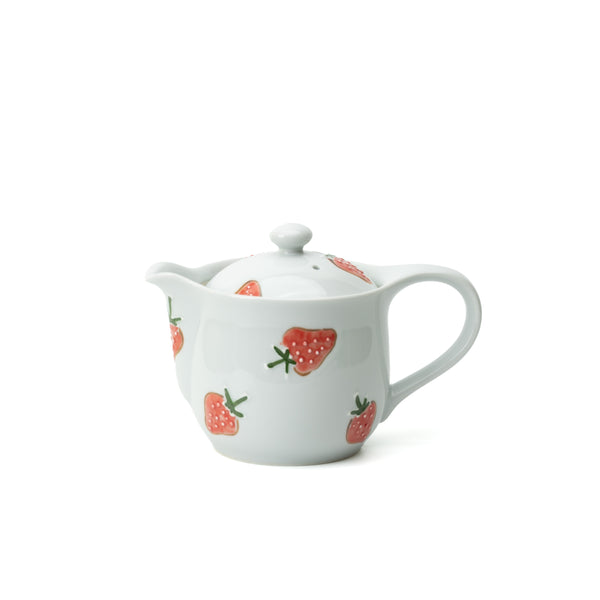
The Tokushichi Strawberry teapot holds approximately 250 ml. The Seikou Kutani Mejiro teapot holds 350 ml, while the Iroe Yū Hidamari cat teapot holds 360 ml. The Tasei Sakura kyusu holds approximately 400 ml and is sold without cups. The Arita Camellia tea set pairs an approximately 410 ml teapot with two matching cups of approximately 140 ml each.
A smaller pot suits someone who prefers a modest serving; a set with two cups gives you a ready-made pairing for sharing. Think about whether you would rather make a smaller amount or have extra room in the pot.
Compare the strainer before choosing
If you are looking for a Japanese teapot with a strainer, read the description closely. Strainers differ in construction and in how you remove spent leaves. Common types include fine holes made in the pot's own ceramic, a stainless-steel mesh fitted inside, and a removable mesh basket. Tea sellers differ on which is best: one Japanese tea company says neither ceramic nor stainless mesh is necessarily better, and that the choice depends on the teas you brew and how you like to brew. The product pages describe these examples as follows:
- Tokushichi Strawberry: “removable mesh strainer.” The page does not specify the mesh material.
- Tasei Sakura: “built-in ceramic strainer.” It stays in the pot, so remove the leaves from the pot after brewing.
- Seikou Mejiro: “removable stainless-steel strainer.” You can lift the strainer out to empty the leaves.
- Iroe Yū Hidamari: “removable mesh strainer.” The page does not specify the mesh material.
- Arita Camellia: the page says the teapot comes with “a tea strainer.” Its type and construction are not specified.
Consider which arrangement you would be happier cleaning after an ordinary cup. Also consider the leaf you drink: larger whole leaves and finely broken leaves, such as deep-steamed sencha, can behave differently. The listings do not specify aperture sizes, so they cannot tell you exactly how much fine leaf will pass through. If that detail matters for your sencha, ask before buying rather than assuming that all strainers perform alike.
Glazed porcelain and everyday tea
The Sakura and Mejiro pages identify porcelain; the Camellia page describes a porcelain set with a deep blue glaze. The Tokushichi page identifies porcelain and raised-glaze decoration. The Hidamari product description does not specify its material or finish; its material field identifies it as ceramic. The Tasei listing also notes an unglazed area on the underside that may show slight darkening from production.
Tea sellers often point out that unglazed clay, such as Tokoname red clay, is slightly porous and can pick up aromas, so many drinkers keep one unglazed pot for one kind of tea. A glazed pot is generally easier if you rotate between different teas. Some drinkers also say unglazed clay softens the edges of a tea; that is a personal impression, not an established flavor advantage. Choose the surface you enjoy using and follow the care guidance for the individual piece. Rinse a glazed pot between teas and let it dry fully. For more on clay kyusu, see our Tokoname ware guide.
Look at the kiln as well as the shape
The name on a listing gives you another way to choose. Tokushichi Kiln (徳七窯) makes the Strawberry teapot, an Arita/Hasami porcelain piece with hand-painted strawberries and raised-glaze outlines. At approximately 250 ml, it is the smallest example here and comes with a removable mesh strainer.

Tasei Kiln (田清窯) is identified on the Sakura page with Arita in Saga Prefecture. Its pink porcelain pot has a cherry blossom on the lid and a painted heart at the end of the side handle. If you want the pot alone and like a built-in ceramic strainer, this is a practical choice.

Seikou Kiln (青郊窯) is named on the Kutani Mejiro page. Green mejiro birds sit among leafy branches on its porcelain body. Its removable stainless-steel strainer gives it a different practical character from the Tasei pot; look at both the artwork and the way you prefer to empty the leaves.

Iroe Yū (色絵 遊) makes the Hidamari series shown on the cat teapot's page. Cats, flowers and butterflies decorate the pot, with flowers continuing onto the lid. The removable mesh strainer and 360 ml capacity are the practical details to compare with the Seikou piece.

The Arita Camellia set takes a different approach: red and white camellias appear against deep blue glaze, and the teapot comes with two matching cups. Its page describes the set as Arita porcelain made in Japan but does not name a specific kiln, so choose it for the coordinated set rather than for a particular maker.

How to use a kyusu for sencha
Sencha recipes vary, so start with the instructions on your tea package. As one published example, Ippodo's standard sencha recipe uses 10 g of leaves (about two tablespoons), 210 ml of 80°C water and a 60-second steep. The stated capacities of all five pots above exceed 210 ml; allow room for the leaves when brewing.
- Prepare the water: boil it, then let it cool to the temperature your tea recommends. A thermometer makes this repeatable.
- Put the leaves in the pot. If your pot has a removable strainer, set it in place first.
- Add the water and steep for the time your tea suggests; leaf and personal taste vary.
- Hold the lid securely as you pour. If serving several cups, alternate between them a little at a time so each receives tea from across the pour.
- Empty the leaves after brewing. Rinse the pot and strainer, and let the pieces dry before putting them away. Follow the individual product's care instructions, especially for washing and microwave use.
For more detail, read our kyusu care guide, or our beginner's guide to brewing sencha at home.
Which one should you choose?
Start with the handle if comfort matters most: the Tasei Sakura has a side handle, and the other four appear to have a handle at the back in their product photos. Start with the strainer if cleanup is your priority: the Seikou and Iroe Yū pages specify removable strainers, and the Tasei has a built-in ceramic one. Start with the Camellia set if you want matching cups included. Then choose the kiln or decoration you would enjoy seeing on your table. Explore the teapots and tea sets collection, or look more closely at Arita and Hasami ware and Kutani ware.