Banko Ware: The Mie Tradition Behind Japan's Donabe
Escrito por el equipo de ZenKiln · desde nuestro atelier de Tokio
Somewhere under almost every Japanese hot pot sits a piece of Banko ware (萬古焼, Banko-yaki). The tradition, centered on the port city of Yokkaichi in Mie Prefecture, produces 80 to 90 percent of Japan's donabe — the earthenware pots that go over direct flame for rice, oden, and winter nabemono — along with the unglazed purple-clay teapots known as shidei kyūsu. Yet Banko ware did not begin in a kitchen. It began as a tea merchant's private kiln and a two-character wish for permanence. This guide covers the seal that named the craft, the revival that industrialized it, the lithium-bearing clay that lets a Banko pot sit calmly in fire, and how to choose a Banko donabe for your own table.
What is Banko ware?
Banko ware (Banko-yaki) is a Japanese ceramic tradition made in and around Yokkaichi, in Mie Prefecture. Its two signature products are donabe — heat-resistant earthenware cooking pots — and shidei kyūsu, unglazed teapots in iron-rich purple clay. Banko kilns account for 80 to 90 percent of all donabe produced in Japan, and the craft was designated a national Traditional Craft, as Yokkaichi Banko ware, in 1979.
Banko is unusual among Japanese ceramic traditions in that it is not named for a place. Shigaraki, Seto, and Arita are toponyms — you can visit them on a map of Japan's pottery regions. Banko is named for a hope. Its founder stamped his work banko fueki (萬古不易), "eternal and unchanging," and the seal became the ware. The tradition it named is anything but frozen: more than one hundred Banko-related companies still work in the Yokkaichi area today, according to the cooperative's Banko no Sato Center.
A tea merchant's seal
Nunami Rōzan was born in 1718 to a wealthy merchant family in Kuwana. Devoted to chanoyu — the tea ceremony — from childhood, he opened a private kiln in the Kuwana area between 1736 and 1740 to make tea utensils, stamping each piece banko or banko fueki in the hope that it would be handed down and used for generations. The account is kept both by the Banko cooperative and by KOGEI JAPAN, the national directory of designated traditional crafts.
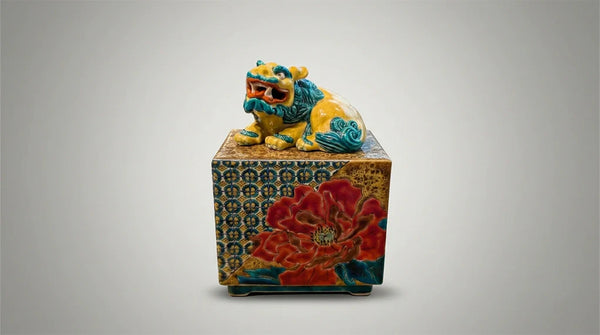
Rōzan was an educated amateur with adventurous taste rather than a workshop potter. Said to have learned in the tradition of the Kyoto master Ogata Kenzan, he worked in the decades after the shogunate loosened its ban on Western books, and the era's appetite for the foreign shows in his work: akae enamel fabric patterns, motifs borrowed from Dutch lettering, and animals almost no one in Japan had seen — lions, giraffes, elephants. His fame reached Edo, where, by the cooperative's account, he opened a second kiln and won the shogunate's patronage. Collectors call this first flowering Ko-Banko, "Old Banko."
Rōzan died in 1777 without a successor, and Banko ware simply stopped. What survived was the seal — and in time the wish stamped into it came literally true. The name outlived the man, waiting for someone to pick it back up.
Revival, wooden molds, and the move to Yokkaichi
Decades later the brothers Mori Yūsetsu and Senshū reopened production and revived the ware, adding inventions of their own. The most consequential was Kata-Banko: teapots formed over collapsible wooden molds, which came apart and slipped out through the mouth once the walls had set. The method made teapots remarkably thin and light, with inventive details — rotating lid knobs, a water-dragon pattern engraved into the mold so that it appeared inside the pot — and a bright pink shōenji glaze made with a trace of gold. Kata-Banko pots became favorite souvenirs along the Tōkaidō road.
The step that turned a revival into an industry came from Yamanaka Chūzaemon, a village officer in Suenaga, part of present-day Yokkaichi. His village sat between two flood-prone rivers and its farmers were chronically poor; Chūzaemon spent roughly twenty years working out how to mass-produce Kata-Banko ware, then gave villagers tools and clay and trained them at his own expense. With Yokkaichi's port, and later its railways, Banko ware spread across Japan and into export markets. When the local white clay began to run out in the mid-Meiji era, makers developed an iron-rich body in its place — the origin of shidei, the purple clay now synonymous with Banko teapots.
Petalite: the pot that sits in fire
A Banko donabe tolerates direct flame because its clay is blended with about 40 percent petalite, a lithium-bearing mineral with very low thermal expansion. The Banko industry developed the blend in 1959, and KOGEI JAPAN describes it as a patented technique of the region. A petalite body heats slowly, spreads heat evenly, and keeps cooking on residual heat after the burner is off — the properties that made the Banko donabe standard equipment in Japanese kitchens.
Ordinary low-fired clay dislikes sudden heat; a pot moved carelessly between cold and flame is how most earthenware dies. Petalite changed that arithmetic, and donabe cooking is built on the result: rice that finishes steaming after the flame is out, broth that holds a gentle simmer at the table, ingredients heated slowly enough that the cooperative describes the pot as drawing out sweetness and umami. Reduction firing — starving the kiln of oxygen — gives Banko ware its characteristic deep russet color. To place earthenware among Japan's ceramic bodies, see our guide to stoneware versus porcelain; and the tradition keeps pace with modern kitchens, with makers now building donabe for induction cooktops as well.
Shidei: the purple-clay kyūsu
In the late Edo period, loose-leaf green tea spread to the general public, and the Kata-Banko workshops caught the moment. The shidei kyūsu — a small teapot in purplish, dark-brown clay, left unglazed — became Banko's second hallmark and remains so today. The color comes from iron in the clay reacting with the kiln's flame, and the unglazed surface takes on a deeper sheen with years of handling. The cooperative cites studies suggesting the iron binds some of the tea's tannins and softens bitterness; when Banko ware received its Traditional Craft designation in 1979, the teapots were named first.
There is a local logic to the pairing. Mie is Japan's third-largest tea-producing prefecture, and Yokkaichi is known for kabuse-cha, a shade-grown green tea — local leaf for the local pot. One caution with any unglazed kyūsu, Banko or Tokoname: never wash it with soap. Our kyūsu care guide explains why, and what to do instead.
Younger than the Six Ancient Kilns — and on more stoves
Banko ware carries none of the medieval romance of the Rokkoyō, the Six Ancient Kilns — Shigaraki, Bizen, Tamba, Echizen, Seto, and Tokoname — which have fired continuously since the medieval period. It began as one Edo-period tea lover's project and grew up as a modern industry. Yet measured by daily use it out-ships them all: eight or nine of every ten donabe in Japan come out of Banko kilns. Where most famous wares compete on glaze and silhouette, Banko competes on what happens inside the pot. Its tradition is heat engineering — a lineage of making things that survive fire and improve dinner, unchanged in purpose since a merchant stamped "eternal" into wet clay.
Choosing a Banko donabe — the ZenKiln catalogue
Donabe are sized in gō (号), and the numbers run practical: a 6- or 7-gō pot suits one or two people, an 8-gō serves two to three, and a 9- or 10-gō pot feeds a family table. From the Banko pieces we stock and ship from Japan:
- Ginpo's Hana-Mishima donabe — the classic white slip-inlay floral band on russet clay, available in sizes 6 through 10.
- The same pattern in an induction-compatible 7-gō model — Banko clay adapted for IH cooktops.
- A hand-painted 9-gō donabe from Studio Yuzuriha, a Yokkaichi maker's studio line, with green-and-rose overglaze on the lid.
- A rose donabe pairing a Banko body with a Seto-painted lid — two traditions in one pot, from the Afuku kiln.
- For the table around it: Hana-Mishima tonsui side bowls and the matching renge ladle and rest set.
The full line lives in our Japanese Donabe & Clay Pots collection. Before the first meal, season the pot — our donabe care guide walks through first-use seasoning, daily cooking, and storage.
FAQ
What is Banko ware known for?
Banko ware, from Yokkaichi in Mie Prefecture, is best known for donabe — earthenware cooking pots that tolerate direct flame — and for shidei kyūsu, unglazed purple-clay teapots. Banko kilns produce 80 to 90 percent of Japan's donabe, and the craft was designated a national Traditional Craft in 1979.
Why can a Banko donabe sit over an open flame?
Because of its clay recipe. Banko donabe bodies are blended with roughly 40 percent petalite, a lithium mineral with very low thermal expansion, a formulation the industry developed in 1959. The pot heats slowly and evenly and resists the sudden temperature swings that crack ordinary earthenware — though it should still be seasoned before first use and never heated empty.
What is a shidei kyūsu?
A shidei kyūsu is a Banko-ware teapot made from iron-rich "purple clay" and fired unglazed, usually in a small side-handle form. The iron gives the pot its dark, purplish-brown color, and the surface gains a soft sheen with use. The Banko cooperative cites studies suggesting the iron softens tea's bitterness by binding tannins.
Is Banko ware one of the Six Ancient Kilns?
No. The Six Ancient Kilns — Shigaraki, Bizen, Tamba, Echizen, Seto, and Tokoname — are medieval traditions that have fired continuously for centuries. Banko ware began in the mid-18th century as the private kiln of the tea-loving merchant Nunami Rōzan and industrialized in Yokkaichi in the 19th century. It is younger, but it dominates Japan's donabe production.
What size donabe should I buy?
Donabe are sized in gō (号). As a working rule, a 6- or 7-gō pot suits one or two people, an 8-gō pot serves two to three, and 9- to 10-gō pots suit families and dinner parties. Choose by how many bowls you actually fill: nabemono is cooked at the table, so the pot should match the seats around it.
A note from ZenKiln: we're a Tokyo studio that works directly with Japanese kilns and makers — the Banko pieces above come from Ginpo, Studio Yuzuriha, and the Afuku kiln — and we ship from Japan. We describe traditions in our own words and link to the Banko cooperative's center and Japan's traditional-crafts directory for the historical record.