Arita Ware: The Story of Japan's First Porcelain
4 min readArita, in present-day Saga Prefecture, was an early centre of Japanese porcelain production in the seventeenth century. Its kilns made underglaze blue-and-white, enamelled and gilded wares for customers in Japan and overseas. Several names associated with this history—Kakiemon, Ko-Imari and Nabeshima—describe different kinds of work, rather than a single set of decorative techniques.
This guide explains those names and Arita’s relationship with Imari. For the wider context, see Japan’s pottery regions and Japanese stoneware versus porcelain.
A Korean potter, a white stone, and Japan’s first porcelain
Porcelain production developed in Hizen after the Japanese invasions of Korea in the 1590s, during which Korean potters were forcibly brought to Japan. Their skills contributed to the region’s ceramic industry and kiln technology. Suitable porcelain stone was another essential part of the later development.
The traditional account credits a Korean potter known in Japan as Kanagae Sanbee, also called Ri Sanpei (Yi Sam-pyeong), with finding porcelain stone around 1616. By about 1630, abundant high-quality stone at Izumiyama supported larger-scale production. The origin account and the evidence for later industry should be read separately.

Why Arita is not one of the “Six Ancient Kilns”
The Six Ancient Kilns are a historical grouping of medieval production centres. Arita’s porcelain developed later. The distinction is chronology and production history, not a division between rustic tea objects and refined tableware: Seto made applied glazes, and the regions have produced many kinds of vessels. Read Japanese ceramics and our Shigaraki ware guide for comparison.
Blue-and-white first, then color: sometsuke, Kakiemon, and Ko-Imari
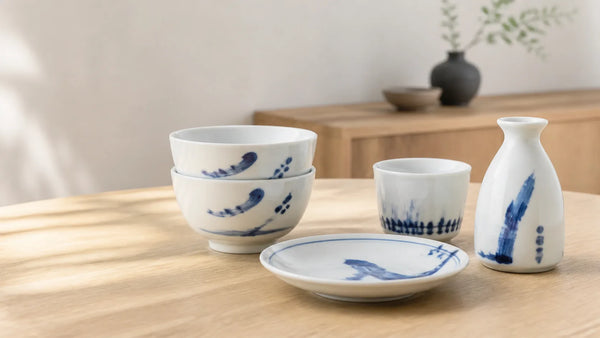
Sometsuke (染付) uses cobalt decoration beneath a clear glaze. It appears in early Arita porcelain and remains in production today; the number of firings varies by process. The Arita sometsuke oval platter is a contemporary example with shōchikubai motifs: pine, bamboo and plum.
Overglaze enamel decoration developed in the 1630s. Coloured enamels are painted over the fired glaze and fixed in a subsequent, lower-temperature firing. The terms iroe (色絵) and akae (赤絵) refer to coloured enamel decoration and, in the latter case, the emphasis on red.
Kakiemon takes its name from the Kakiemon kiln in Arita. Its birds, flowers and figures are often spaced across a milky-white nigoshide body. Other makers use related designs: our Kakiemon-style cup and saucer has a plum-blossom-and-bird motif. “Kakiemon-style” does not establish production by that kiln or use of nigoshide.

Ko-Imari (“Old Imari”) is a historical umbrella for older porcelain, not just a gold-rich decorative style. Some examples are blue-and-white; others use enamels and gilding. Kinrande names gold-brocade decoration. Compare the contemporary Ko-Imari lidded bowl and red-and-gold kinrande chrysanthemum cup and saucer as style references.

Nabeshima: porcelain for official gifts
Nabeshima ware was made for the domain’s official gift-giving rather than ordinary commercial sale. Production became associated with Okawachiyama, now in Imari City. It includes blue-and-white, celadon, and enamelled work, with carefully controlled designs; it is not solely an overglaze style.
Imari: the port that gave the ware its export name
Historically, Arita-area porcelain travelled through Imari before overseas shipment from Nagasaki. This trade helped establish “Imari” as a name in collecting and export markets. Today Imari is also a production location, so the two place names should not be treated as interchangeable on every modern listing.
Dutch traders based at Deshima in Nagasaki carried Japanese porcelain overseas during Japan’s restrictions on foreign trade. Disruption to Chinese supplies helped create an export market for Japanese producers. In the later seventeenth century, Arita porcelain reached European collections and influenced European ceramic designs.
How to recognize — and start collecting — Arita porcelain
Start with the maker or production record, then compare the body and decoration. Colour, translucency and a ringing sound alone cannot authenticate Arita porcelain. For everyday use, follow the item’s appliance and care guidance, especially where gold is present.

Arita ware in the ZenKiln catalogue
These contemporary examples show some of the decoration discussed above:
- Arita Sometsuke Oval Platter — Shōchikubai: pine, bamboo and plum in cobalt blue.
- Arita Kakiemon-Style Cup & Saucer: plum blossom and birds on a pale ground.
- Arita Ko-Imari Lidded Bowl: phoenix, peony and bird motifs in blue, red and gold.
- Arita Red & Gold Kinrande Cup & Saucer: gilded chrysanthemum decoration.
- Arita Hakuji Wind Chime: a white-porcelain fūrin with painted decoration.
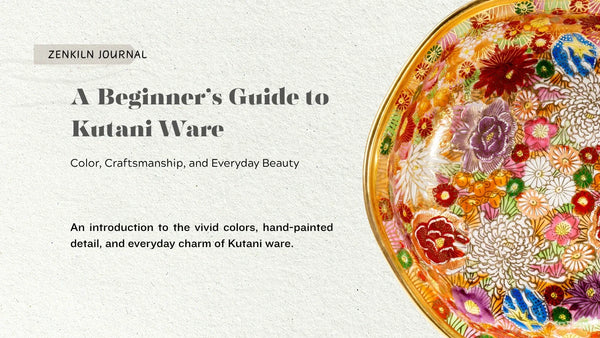
Browse Arita & Hasami Ware for current availability. Our Kutani ware guide introduces a separate porcelain tradition and its painted designs.
Sources: The Metropolitan Museum of Art and the Saga Ceramics Industrial Association. Traditional origin accounts are identified as such. ZenKiln editorial team.