| Form |
Kabin (花瓶) — tall baluster presentation flower vase, flared rim |
| Size |
Height 32.0 cm (12.6″) · mouth Ø 8.5 cm (3.3″) · foot Ø 10.5 cm (4.1″) |
| Weight |
Not published by the maker — will be weighed before dispatch |
| Material |
Porcelain (磁器 jiki), Arita-yaki |
| Exterior glaze |
瑠璃釉 (ruri-yū) deep midnight cobalt-blue ground |
| Decoration |
金彩 (kinsai) married-pair cranes (夫婦鶴 fūfu-zuru) — one gold-gilt, one silver-platinum, each flight feather engraved; gold rim line, neck cusp frieze, foot band |
| Interior |
White porcelain, visible at the mouth and gold-bordered foot |
| Foot mark |
蘭花 (orchid) emblem above 「香蘭社」 in underglaze cobalt |
| Motif |
夫婦鶴 (fūfu-zuru) married-pair crane — longevity, fidelity, good fortune |
| Maker |
香蘭社 Kōransha, Arita (founded 1879) — parent house of Fukagawa Seiji; Imperial Household supplier since the Meiji era |
| Era |
Late Shōwa–Heisei, estimated 1980s–2000s (documented vintage) |
| Condition |
Excellent — no chips, no hairlines; gold & silver intact; unrestored |
| Tomobako |
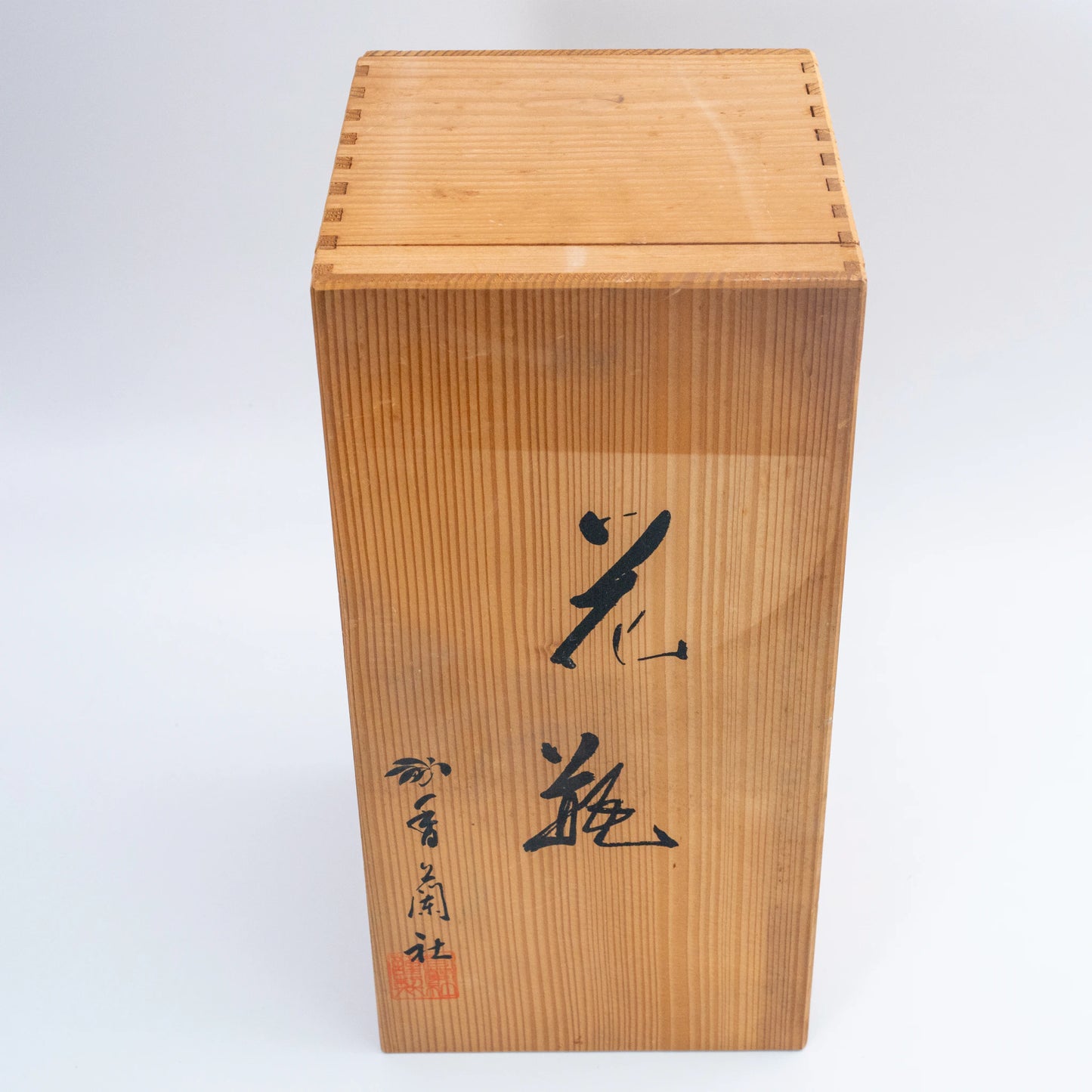
Original paulownia kiribako (tall, dovetail-jointed), signed & stamped |
| Included |
Vase + original signed tomobako |
Vintage Koransha ruri-cobalt crane kabin — gold & silver fūfu-zuru
A tall, presentation-grade baluster vase (花瓶 / kabin) by 香蘭社 Kōransha — one of the oldest continuously-operating Arita porcelain houses — finished in a deep ruri (瑠璃) cobalt glaze brought to a true midnight intensity, the white porcelain showing only at the mouth and through the gold-bordered foot. Across the body, two cranes (鶴 tsuru) are worked in elaborate kinsai (金彩): one gilded fully in gold, the other in silver-platinum, each flight feather individually engraved through the metal in the high-precision style for which Kōransha is recognized. A continuous gold line frames the mouth; an arch-and-dot frieze of fine gold cusps runs the neck, and the pedestal foot carries a matching gold band.
Maker & provenance
• Made by Koransha / Arita-yaki in Saga Prefecture, Japan, curated by ZenKiln — a documented vintage piece acquired from a Japan-based sourcing studio.
Attribution rests on a three-point closure standard:
- Underglaze foot mark — a stylized 蘭花 (orchid) emblem above 「香蘭社」 in cobalt
- Tomobako lid calligraphy — 「花瓶」 (kabin)
- Tomobako side calligraphy — 「香蘭社」 with the red house seal
Maker attribution is definitive (orchid foot mark + signed tomobako). Dating is estimated — late Shōwa to Heisei, roughly the 1980s–2000s — inferred from the tomobako condition, the decoration style, and the gold-application technique consistent with Kōransha production from that window. The 1879 founding date in the house's history is its founding year, not this vase's production year.
About Kōransha (香蘭社)
Kōransha was founded in 1879 in Arita by 八代 深川栄左衛門 (the 8th-generation Fukagawa Eizaemon) together with other Arita masters as the first jointly-incorporated Arita export-porcelain company; it took its name and house mark from the orchid blossom (蘭花). The house has supplied the Imperial Household since the Meiji era and remains in operation today. In 1894 the founder's second son, 深川忠次 (Tadatsugu Fukagawa), left Kōransha to establish 深川製磁 Fukagawa Seiji — making Kōransha the elder "parent" house from which the now better-known Fukagawa Seiji branched. This vase is from the original Kōransha lineage.
The crane motif
The two cranes read as a fūfu-zuru (夫婦鶴), a married-pair crane. In Japanese decorative art the crane is the enduring symbol of longevity, marital fidelity, and good fortune — which makes the piece especially suited to a wedding, anniversary, or milestone gift, or simply to a corner that wants something of stature.
Condition
Excellent. The cobalt glaze surface is clean and glossy, with no chips and no hairlines in the photographed angles; the gold linework and silver gilding are intact and unworn. Unrestored and unrefinished. Additional close-up photos of the mark, foot, or any detail are available on request before purchase.
Display & use
A statement vase for a tokonoma alcove, a formal-room console, a fireplace mantel, or a curated bookshelf. The narrow mouth (8.5 cm) holds a single tall stem — lily, peony, branch ikebana — or a small kenzan pin-frog for low-water work, but at 32 cm the vase is a presentation piece first and an arrangement vessel second.
Care
Hand-wash only with lukewarm water and a soft cloth. Avoid abrasive sponges, dishwashers, microwaves, and direct sunlight. The kinsai gold and silver are sensitive to friction — do not scrub. If arranging fresh flowers, line the interior with a glass tumbler to protect the glaze from mineral residue.
Included
- 1 × Kōransha ruri-cobalt presentation kabin
- 1 × original signed paulownia tomobako
- Hand-packed in archival tissue inside a double-walled carton from Japan; insured in transit
About ZenKiln — A Japan-based curator connecting international collectors with Japan's artisan ceramic tradition. We work closely with the kilns, workshops, and makers featured in our shop — each one disclosed in our About section — and hand-pack every piece in Japan for safe delivery worldwide.
📦 Ships from Japan, hand-packed for safe delivery.