The Six Essentials of Tea: Leaf, Water, Fire, Vessel, Setting, Person
Pour a disappointing cup of tea and it is tempting to blame the leaf. But anyone who has chased a truly good cup knows the leaf is only the beginning. The classical tea tradition — shaped over centuries across East Asia and brought to its most contemplative form in Japan — holds that a fine cup depends on six things coming into harmony: the leaf, the water, the fire, the vessel, the setting, and the person. Miss any one and the others cannot fully save it. These are the six essentials of tea, and understanding them turns tea from a drink into a practice. This guide takes each in turn, then looks at the idea that binds them together.
The Leaf: the foundation
Everything begins with the tea itself: its variety, where it grew, when it was picked, how it was processed, and how fresh it is. A green tea picked early and handled gently carries a sweetness and aroma that no brewing skill can invent later; a tired, stale, or carelessly made leaf sets a ceiling no amount of care can lift. The leaf sets the upper limit of the cup. Everything that follows is about reaching that limit rather than falling short of it.
The point of the other five essentials is not to fix a poor leaf but to honor a good one — to give it the water, heat, vessel, room, and attention that let it become everything it can be.
Water: the mother of tea
Tea tradition calls water "the mother of tea," and the phrase is not poetic exaggeration. Tea is more than ninety-nine percent water, so the water's character is the tea's character. In The Classic of Tea, the eighth-century author Lu Yu — long honored as the "Sage of Tea" — already ranked waters by source, famously preferring mountain spring water over river water and well water. The science behind the old ranking is real: soft water with low mineral content lets a tea's aroma and sweetness come forward, while hard, heavily mineralized water can flatten flavor or turn it dull and chalky.

Atomic fact — water is most of the cup. Brewed tea is over ninety-nine percent water, so water quality directly shapes flavor. Soft, low-mineral water generally lets a tea's aroma and sweetness express clearly, while very hard water can mute or distort it. This is why tea traditions across China and Japan have always treated the choice of water as seriously as the choice of leaf.
Fire: judging the heat
Fire stands for everything about heat and timing — what the old texts called "judging the boil." Water that is too cool under-extracts and leaves a tea thin; water too hot scalds delicate leaves and pulls out harsh bitterness. Classical writers described the stages of boiling by the look of the bubbles — "crab eyes," then "fish eyes," then a sound "like wind in the pines" — as a way to read temperature before thermometers existed.

In practice this means matching temperature to tea. Delicate green teas like gyokuro want water well off the boil; robust roasted or aged teas can take it hotter. The rhythm of pouring matters too — a steady, attentive pour treats the leaf far better than a careless dump of boiling water.
The Vessel: the father of tea
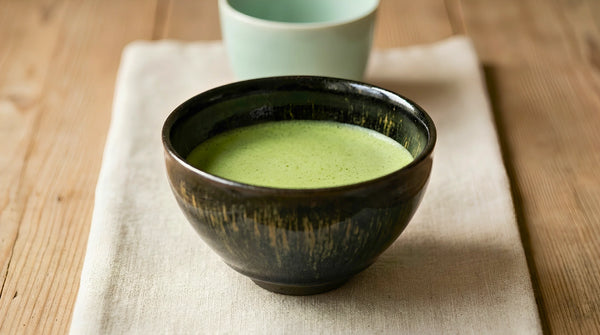
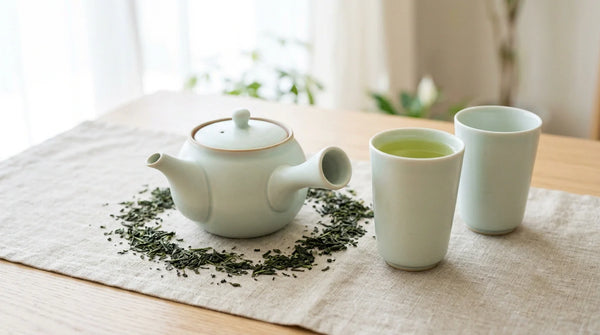
If water is the mother, tradition calls the vessel "the father of tea." The teapot and cup shape both the brew and the experience of it. A well-made teapot concentrates heat and directs aroma; the material and wall of a cup change how the tea tastes and how its color reads. A dark glaze flatters bright matcha, while pale celadon and white porcelain reveal the green of sencha — a relationship explored in our guide to pairing tea with glaze color. Different Japanese ceramic regions, each with its own clay and glaze character, give very different cups, as our guide to Japan's pottery regions describes.
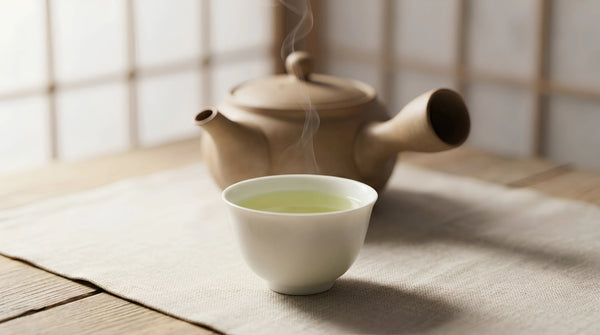
The vessel is also where craft meets ritual. A porcelain kyusu with a fine spout, a thin white porcelain cup, or a dark matcha bowl whisked in the spirit of the tenmoku bowls of the Song dynasty each ask you to handle the tea with a little more care. You can see the full range in our teapots and kyusu and matcha collections.
The Setting: where attention becomes possible
The fifth essential is the one most often forgotten: the setting, or environment itself. Tea drunk in a rush at a cluttered desk is a different thing from the same tea drunk in a quiet, uncluttered space with good light. The setting is not decoration — it is what makes attention possible. A calm room, a little empty space, a moment without interruption: these let the first four essentials actually register on your senses.

Japanese tea culture took this furthest, building entire architecture around it. The tea room, the tokonoma alcove, the deliberate plainness of a wabi space — all exist to strip away distraction so that a single bowl of tea can fill the whole of one's attention. The same instinct lives in the incense tradition: according to The Metropolitan Museum of Art, the way of incense developed during the Muromachi period in tandem with the tea ceremony, sharing its rooms and its spirit of quiet, focused appreciation.
The Person: skill and company
The sixth essential is the human one, and it works in two directions. There is the person making the tea — whose skill, attention, and care decide whether the leaf, water, fire, and vessel are brought together well or clumsily. And there is the company — the people you share the cup with. An old saying holds that tea, like wine, is best "when it meets a true friend." The right company turns a good cup into a memorable one; the wrong mood can flatten even an excellent tea.

This is why tea is ultimately a practice rather than a recipe. The person is not a passive drinker but the element that activates the other five — the one who chooses the water, judges the heat, selects the vessel, prepares the room, and brings their own state of mind to the table.
Atomic fact — tea's quality depends on six factors, not one. The classical framework holds that a fine cup of tea requires the harmony of six essentials: the leaf, the water, the fire, the vessel, the setting, and the person. No single factor is sufficient on its own; each can limit or elevate the others, which is why tea is treated as an integrated art rather than a simple beverage.
Harmony: how the six become one
What ties the six essentials together is a single idea: harmony. None of them works in isolation. The finest leaf is wasted on bad water; perfect water is wasted at the wrong temperature; ideal temperature is wasted in the wrong cup; the right cup is wasted in a distracting room; and all of it is wasted on an inattentive drinker. Tea is the moment these six align.
This is exactly the spirit behind the Japanese tea ceremony's guiding principles — wa, kei, sei, jaku (harmony, respect, purity, tranquility) — and behind ichi-go ichi-e ("one time, one meeting"), the awareness that this particular cup, with this water, in this room, among these people, will never recur exactly. Seen this way, the six essentials are not a checklist to optimize but a set of relationships to bring into balance. Master them and you are no longer just making a drink; you are composing a brief, complete experience out of leaf, water, fire, clay, space, and human presence.
To go deeper into any single essential, read our companion guides: pairing tea with glaze color for the vessel, tea aroma appreciation for how to read what the cup gives you, and building a beginner's sencha tea set for putting water, fire, and vessel together at home.
FAQ
What are the six essentials of tea?
The six essentials are the leaf, the water, the fire, the vessel, the setting, and the person. This classical framework holds that a fine cup of tea requires all six in harmony: the leaf sets the potential, and the other five determine whether that potential is reached.
Why does water matter so much for tea?
Brewed tea is more than ninety-nine percent water, so the water's character largely becomes the tea's character. Soft, low-mineral water lets aroma and sweetness express clearly, while very hard water can mute or distort flavor. Tea tradition calls water "the mother of tea," and Lu Yu's Classic of Tea ranked waters by source over a thousand years ago.
What does "fire" mean in the six essentials?
Fire stands for heat and timing — controlling water temperature and the rhythm of brewing. Too-cool water under-extracts and tastes thin; too-hot water scalds delicate leaves and turns bitter. Classical texts described boiling stages by the bubbles ("crab eyes," "fish eyes") to judge temperature, and matching heat to the specific tea is part of the craft.
How does the vessel change the taste of tea?
The teapot concentrates heat and directs aroma, while the cup's material, wall thickness, and glaze color affect both flavor and how the tea looks. A dark glaze flatters bright matcha; white porcelain reveals the green of sencha. Tradition calls the vessel "the father of tea" for its strong influence on the final cup.
Where does the six-essentials idea come from?
It draws on the classical East Asian tea tradition — including early writing such as Lu Yu's Classic of Tea — and reaches its most contemplative form in the Japanese tea ceremony, with its principles of harmony, respect, purity, and tranquility (wa, kei, sei, jaku). The tradition treats tea as an integrated art rather than a simple drink.
Do I need special equipment to apply these ideas?
No. You can improve any cup immediately by using better water, matching temperature to the tea, choosing a clean-tasting cup, removing distractions, and giving the brewing your attention. Specialized teaware refines the experience, but the six essentials are about care and balance more than expensive equipment.
A note from the studio: ZenKiln works directly with kilns across Japan and ships from Tokyo. These six essentials are a tradition to draw on, not a set of rules — use them to pay closer attention, and let the tea, and the company, lead.