Seiji: The Jade-Green World of Japanese Celadon
Of all the colors in the Japanese potter's vocabulary, Japanese celadon — known as seiji (青磁) — is the hardest to earn. It is not painted on and it cannot be faked with pigment. The soft jade greens and cool grey-blues of celadon are coaxed out of a thin skin of iron in the heat of a starved kiln, where a single degree or a stray breath of oxygen can turn a masterpiece into a loss. This fifth chapter of Color of Utsuwa follows seiji from the great kilns of China to the Nabeshima domain in Kyushu, and explains why this quiet, jade-like green has been the most coveted — and most feared — color a porcelain potter can chase.
What "seiji" actually means
In the West we call it celadon; in Japan it is seiji, written 青磁 — literally "blue-green porcelain." The name describes a family of translucent, usually pale glazes that range from a barely-there icy blue through willow and jade green to deep olive. What unites them is not a recipe so much as a chemistry: the color is produced by a small amount of iron oxide in the glaze, fired at high temperature in a reducing kiln, one deliberately starved of oxygen.
Get the balance wrong in either direction and the magic collapses. Too little iron drifts toward blue or clear; too much slides through olive into muddy brown and finally black. The reduction atmosphere is what does the real work — it pulls oxygen out of the iron, shifting it from one chemical state to another, and it is that shift that releases the green. Celadon is, in a real sense, a color you fire rather than a color you apply.

Atomic fact — the chemistry of celadon. The celadon color comes from roughly 0.75%–2.5% iron oxide in the glaze, fired above about 1,200°C in a reducing (oxygen-starved) kiln. As the iron converts from ferric to ferrous (Fe₂O₃ → FeO), the glaze turns from grey toward the classic green and blue-green. Individual pieces in a single kiln load can emerge in noticeably different shades depending on where they sat in the heat.
From Longquan to Japan: how the color traveled
Celadon is old. Green-glazed "proto-celadon" shards survive from as far back as the Han dynasty in China, and by the Song dynasty the glaze had matured into one of the most prized surfaces in the world. The kilns of Longquan in Zhejiang province became synonymous with celadon, alongside the imperial-favored Ru, Guan, and Ge wares whose pale blue-greens Chinese connoisseurs valued above almost anything else. The reason was simple and deeply cultural: celadon's color echoed jade, the most treasured material in China, and to hold a good celadon bowl was to hold something like jade made liquid and set in glaze.
Chinese celadon reached Japan early — pieces had arrived by the Heian period — and the Japanese reverence for it runs so deep that three Chinese celadon flower vases held in Japan are today registered as National Treasures, two from the Longquan kiln in the Southern Song and one Yuan-dynasty vase famous for its scattering of iron-brown spots. For centuries, then, seiji in Japan meant something imported and almost unreachable: a color admired at a distance.

Atomic fact — where the word comes from. "Celadon" is a European coinage, not an Asian one. It is usually traced to 17th-century France and the shepherd Céladon — who wore pale green ribbons — in Honoré d'Urfé's 1627 pastoral romance L'Astrée. Japan never needed the story: there the ware has always simply been seiji (青磁), blue-green porcelain.
Why Japanese potters feared celadon
When Japan finally began producing its own porcelain in the early 1600s, in the Hizen region of northern Kyushu — the birthplace of Arita, Imari, Hasami, and Nabeshima wares — celadon was one of the hardest surfaces to master, and most potters left it alone. The problem was economic as much as technical. Celadon's reduction firing is unforgiving, and historically the loss rate could reach as high as 80 percent: for every finished piece, several cracked, slumped, or came out the wrong color and went to the shard heap. On top of that, the kaolin needed for fine white porcelain was never as abundant in Japan as in China, though Kyushu did have good sources, notably at Amakusa.
So Japanese taste bent in a characteristic direction. Rather than chase the deep, saturated Chinese greens, many Japanese artists and clients came to prefer seihakuji (青白磁) — a "blue-white" porcelain with only the faintest breath of blue-green in an otherwise icy white glaze, where the celadon chemistry is dialed almost to a whisper. It is a restrained, wintry cousin of full celadon, and it sits naturally beside the pure white hakuji we explored in the previous chapter. In the 20th century, the seihakuji tradition was honored at the highest level when a master of the style was recognized as a Living National Treasure.
Nabeshima and Ōkawachiyama: Japan's celadon heartland
The one place in Japan where celadon became a defining specialty was the Nabeshima domain. Between the 17th and 19th centuries, the Nabeshima clan operated closely guarded kilns — most famously in the mountain village of Ōkawachiyama, near Arita in Saga Prefecture — that produced porcelain of extraordinary quality, made not for open sale but as gifts for the shogun and other feudal lords. Nabeshima celadon was worked in the Longquan tradition: repeated coats of iron-bearing glaze built up and fired in reduction until the surface reached its characteristic dense, even green.
Because these were tribute wares held to an exacting standard, Nabeshima seiji carries a discipline you can still read in the pieces — flawless forms, quiet decoration, and glaze applied with the confidence of a workshop that could afford to reject anything less than perfect. That legacy is why, when collectors today speak of Japanese celadon at its finest, the conversation so often returns to Nabeshima and the Arita corridor of Kyushu. The same region's porcelain tradition continues in the workshops whose contemporary pieces we carry.

Reading a celadon glaze: color, crackle, and form
Celadon rewards slow looking. Because the color lives in a translucent glaze rather than on a painted surface, its depth changes with the light and with the thickness of the coat — pooling darker in carved lines and around a foot ring, thinning to near-white over a raised edge. Traditional Chinese celadons are often decorated with nothing but shaping: shallow carving or molding that lets the glaze gather in the hollows and glow more deeply there, so the "pattern" is really an event of light and shadow inside a single color.
Many celadons also carry crackle — a fine web of cracks in the glaze, sometimes an accident of cooling and sometimes deliberately encouraged and even stained to make the network visible. On a good piece it reads not as damage but as a kind of frozen weather across the surface. When you evaluate a celadon utsuwa, look at three things together: the evenness and hue of the green, the presence and character of any crackle, and the way the glaze breaks over the edges of the form. In celadon, form and color are the same subject.

Seiji in the ZenKiln collection
Celadon is one member of a larger family — the high-fired, kaolin-bodied porcelain that Kyushu has made for four centuries. While seiji pushes that porcelain toward jade green, the same lineage also gives us luminous whites, painted enamels, and gilded surfaces. If the quiet, form-first spirit of celadon appeals to you, these porcelain pieces from ZenKiln share its material roots even where they take the color in a different direction:
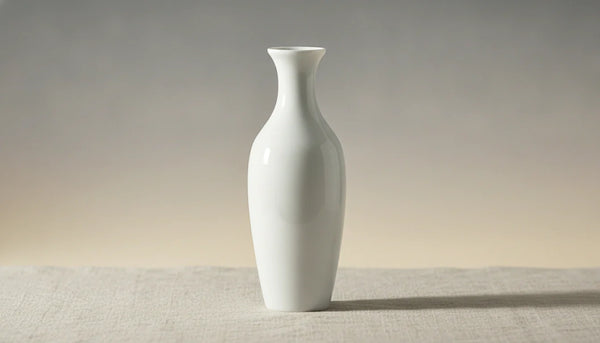
- Fukagawa Seiji Iridescent Porcelain Vase — a single-stem Arita hanaike from a historic Arita porcelain house, its pearlescent glaze a study in how much life a monochrome surface can hold.
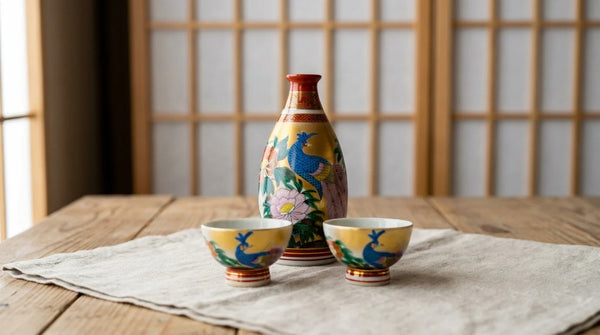
- Kutani Crane Vase — hand-painted porcelain from the Kutani Kayō kiln in Ishikawa, showing the painted, color-forward side of the same porcelain tradition.
- Arita & Hasami Takarazukushi Tea Set — a kyusu and two cups in lustrous white porcelain from the very Kyushu corridor where Japanese celadon was born.
To browse the material more broadly, explore the full Porcelain collection, or focus on the celadon heartland with Arita & Hasami Ware.
This chapter continues our Color of Utsuwa series. If you are working through the porcelain palette in order, read it alongside Hakuji: the quiet power of white porcelain — celadon's closest neighbor through seihakuji — and the earlier chapters on sometsuke cobalt blue and aka-e red enamel.
Frequently asked questions about Japanese celadon (seiji)
What is the difference between celadon and seiji?
They name the same thing from two directions. "Celadon" is a European word for jade-green, iron-glazed ware; seiji (青磁) is the Japanese term, meaning "blue-green porcelain." When you see a Japanese piece described as seiji, it is that country's celadon tradition.
Why is celadon green?
The green comes from a small amount of iron oxide in the glaze, fired at high heat in a reducing (low-oxygen) kiln. The lack of oxygen changes the chemical state of the iron, and that shift produces the characteristic green and blue-green tones. More iron pushes toward olive and brown; less pushes toward blue or clear.
Is celadon Chinese, Korean, or Japanese?
All three, in sequence. Celadon originated in China and reached its heights at kilns such as Longquan. Korea developed its own celebrated Goryeo celadon tradition. Japan received the color from China (partly via Korea) during the Song dynasty and later made it a specialty of the Nabeshima kilns in Kyushu, where it is called seiji.
What is seihakuji?
Seihakuji (青白磁) is "blue-white" porcelain — a glaze that carries only the faintest blue-green tint over an otherwise icy white body. It sits between full celadon and pure white hakuji, and many Japanese artists and collectors have historically preferred its restraint to a deep saturated green.
Does the crackle in celadon mean it is damaged?
No. Fine crackle is a natural feature of many celadon glazes, caused by the glaze and clay body cooling at slightly different rates. On many pieces it is expected, even prized, and is sometimes deliberately encouraged. It is part of the glaze's character, not a crack through the pot.
Why was celadon so hard for Japanese potters to make?
Reduction firing for celadon is highly unforgiving, and historically the loss rate could reach around 80 percent. Combined with limited fine kaolin, that difficulty led many Japanese workshops to favor the gentler seihakuji blue-white, leaving true celadon as a prestige specialty of kilns like Nabeshima.
Editor's note. ZenKiln does not currently stock a dedicated seiji celadon piece; the products linked above are chosen because they share celadon's porcelain body and Kyushu lineage, not because they are celadon-glazed. Where firing techniques, historical dates, and named traditions are cited here, they reflect the broadly documented history of the ware. We describe eras and traditions rather than attributing specific works to specific makers unless we can verify them. — ZenKiln Editorial