Can You Microwave Japanese Pottery? Microwave & Dishwasher Rules by Material
Can you microwave Japanese pottery? Sometimes — but the honest answer depends entirely on what the piece is made of and how it is decorated. A plain glazed porcelain mug and a gold-painted Kutani lucky cat can share the same cabinet, yet one reheats your coffee happily while the other will spark and scorch in seconds. This guide walks through the microwave and dishwasher rules for every material ZenKiln carries — porcelain, stoneware, earthenware donabe, cut glass, lacquerware, and cast iron — so you can use each piece with confidence and keep it beautiful for decades.
None of this is about babying your tableware. Most everyday Japanese ceramics are made to be used. The goal is simply to know which pieces tolerate the heat and abrasion of modern appliances and which ones ask for a gentler, two-minute hand-wash instead.
The one rule that settles most questions: read the care card
Before any material-by-material logic, start with the single most reliable source — the small printed care card (often a 取扱説明 or 陶器の栞) tucked into the box. Japanese makers test their own glazes and decoration, and when a piece is genuinely microwave- and dishwasher-safe, they usually say so in plain symbols on that card or stamped on the base. If the card marks a piece safe, trust it. If the card is silent, treat the piece as hand-wash only until you can confirm otherwise. Silence is not permission.

When the card is long gone, the material and decoration tell you almost everything. The rest of this guide is how to read them.
Porcelain (磁器, jiki): usually the most forgiving
High-fired white porcelain — the body behind most Arita, Hasami, and Kutani tableware — is dense, vitrified, and essentially non-porous. A plain or underglaze-decorated porcelain mug, bowl, or plate is the most likely piece in your cabinet to be both microwave- and dishwasher-tolerant, because the body absorbs almost no water and the cobalt-blue sometsuke pattern sits under the glaze, sealed and protected.
Two cautions still apply. First, decoration that sits on top of the glaze — hand-painted overglaze enamel (iroe), gold, or fine gilt rims — changes the rules (see below), even on a porcelain body. Second, sudden temperature swings are the enemy of any ceramic: don't move a piece from freezer to microwave, and let a hot bowl cool before plunging it into cold water. For the deeper version of this, see our guide to caring for Arita, Hasami, and Kutani porcelain.
Stoneware & earthenware (陶器, tōki): porous, treat with care
Rustic stoneware and earthenware bodies are lower-fired and more porous than porcelain. They feel slightly heavier and more matte, and many show an unglazed foot ring. Because the clay can hold moisture, these pieces are far less appliance-friendly — and the most important example is the donabe.
Unglazed or porous clay absorbs water like a sponge. In a microwave, that trapped moisture heats unevenly and stresses the wall from the inside out; in a dishwasher, the body soaks up water and detergent that later seep back into food and weaken the clay over repeated cycles. Porous earthenware is fundamentally a stovetop-and-hand-wash material, not an appliance one.
A donabe (土鍋) is built for direct flame, not for the microwave or dishwasher. Banko-yaki clay from Mie Prefecture contains petalite, which gives donabe their famous resistance to thermal shock over an open gas flame — but that same porous body should be hand-washed, dried thoroughly, and never run through a dishwasher cycle. A wet donabe stored in a cupboard can also develop mildew, so airing it out matters more than scrubbing it. Our full donabe seasoning and daily-care guide covers the first-use medome starch seal and storage in detail.

One nuance: a handful of modern donabe and stoneware pieces are marked microwave-safe by their maker for reheating leftovers — this is exactly the case where the care card overrides the general rule. Check the box, and when in doubt, default to the stovetop.
Gold, silver, and overglaze enamel: never microwave
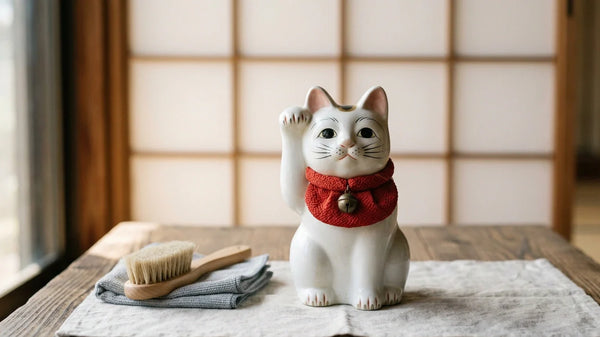
This is the firmest rule in the guide, and it has nothing to do with the clay underneath. Any piece decorated with metallic gold (kinsai), silver, or platinum lustre must stay out of the microwave entirely — whether it's a Kutani kinrande sake cup, a gilt-rimmed mug, or a gold-accented maneki-neko.
Gold, silver, and platinum decoration on ceramics is real metal: a microscopically thin film fused onto the glaze. Microwaves induce electrical currents in metal, and on a thin painted line that energy has nowhere to dissipate, so it discharges as visible sparks — called arcing. Arcing scorches the decoration, can crack the glaze, and may damage the oven. There is no safe microwave setting for metallic-decorated ware.
Hand-painted overglaze enamel (iroe) — the bright polychrome that defines much of Kutani and Kyo-yaki — sits above the glaze and is softer than the glassy surface around it. It will not spark like metal, but repeated dishwasher cycles abrade and dull those colors over time, and aggressive detergents can etch them. For any piece with gold or hand-painted overglaze color, hand-washing in warm water with a soft sponge is the way to keep it looking the way it did in the box.

Glass, lacquer, and cast iron: three special cases

Edo Kiriko cut glass. Tokyo's faceted cut glass is a Traditional Craft designated by Japan's government in 2002, made by cutting patterns into two-layer cased (kise) glass. Those deep facets concentrate stress, so thermal shock is the real risk: never pour boiling liquid into a cold glass, and skip both the microwave and the dishwasher's high-heat dry cycle. Hand-wash in lukewarm water and dry with a soft cloth. See our Edo Kiriko glass-care guide for the full thermal-shock walkthrough.
Urushi lacquerware. Natural urushi lacquer is never microwave- or dishwasher-safe. Microwave heat and dishwasher water both cause the wood core to swell and the lacquer film to cloud, crack, or lift. Lacquer is a quick warm-water hand-wash, dried immediately — detailed in our urushi care guide.
Cast iron tetsubin. A cast-iron tetsubin kettle goes on a stovetop, never in a microwave (metal) or a dishwasher (the detergent strips the protective interior and invites rust). It is hand-rinsed with water only — no soap — and dried over residual heat. The Nambu tekki tetsubin guide covers seasoning and rust.
Quick reference by material
As a memory aid: plain/underglaze porcelain — usually microwave- and dishwasher-tolerant, but confirm on the card. Porous stoneware and donabe — stovetop and hand-wash; microwave only if the maker marks it. Gold/silver/overglaze enamel — never microwave; hand-wash. Cut glass — hand-wash, avoid thermal shock. Lacquerware — hand-wash only, never heat. Cast iron — stovetop only, water-rinse, no detergent. When two signals conflict, the gentler choice is always the safe one.
ZenKiln pieces to care for this way
These verified pieces from the shop show how the rules play out across materials — each one ships with a Japanese care card noting its safe handling:
- Arita-Hasami Faceted Sometsuke Bowl — high-fired porcelain with underglaze cobalt; marked microwave- and dishwasher-safe on its care card, the most forgiving end of the spectrum.
- Arita-yaki Bunzan Peony Mug — porcelain with raised icchin relief; marked dishwasher-safe, a good everyday workhorse.
- Ginpo Hanamishima Donabe — porous Banko-yaki earthenware built for the gas flame; hand-wash and dry thoroughly, never the dishwasher.
- Edo Kiriko Kagome Cut-Glass Pair — faceted cased glass; hand-wash only, away from heat and thermal shock.
- Kutani Gold Calico Maneki-neko — gold-decorated Kutani porcelain; a display piece that must never enter a microwave.
Browse the full Japanese drinkware collection for everyday cups and mugs, or the donabe & clay pots collection for stovetop cookware. New to a piece? Start with our first-use guide for new Japanese tableware.
Frequently asked questions
Is Japanese porcelain microwave safe?
Plain or underglaze-decorated porcelain — the kind behind most Arita, Hasami, and Kutani everyday tableware — is usually microwave-tolerant because the body is dense and the pattern is sealed under the glaze. The exception is any piece with gold, silver, or hand-painted overglaze decoration, which should never be microwaved. When the maker's care card marks a piece safe, follow it.
Can you put a donabe in the microwave or dishwasher?
As a rule, no. A donabe is a porous earthenware pot designed for direct stovetop flame. Its clay body absorbs water, so a dishwasher cycle soaks it with detergent and the microwave heats trapped moisture unevenly. Hand-wash it, dry it completely, and store it where air can circulate. A few modern donabe are marked microwave-safe for reheating — only those, and only per the maker's instructions.
Why does gold-decorated pottery spark in the microwave?
Gold and silver decoration is a thin film of real metal fused to the glaze. Microwaves induce electrical currents in metal, and on a fine painted line that energy discharges as sparks (arcing), which scorches the decoration and can crack the glaze or damage the oven. There is no safe way to microwave metallic-decorated ceramics — hand-wash them and reheat food in a plain dish instead.
Is it safe to put hand-painted Kutani or Kyo-yaki in the dishwasher?
It's best not to. Hand-painted overglaze enamel (iroe) sits above the glaze and is softer than the surrounding surface, so repeated dishwasher cycles gradually abrade and dull the colors, and strong detergents can etch them. A gentle warm-water hand-wash with a soft sponge preserves the brightness for far longer.
Can Edo Kiriko cut glass go in the dishwasher?
No. The deep hand-cut facets concentrate thermal and mechanical stress, so the dishwasher's heat and the risk of knocks make cracking far more likely. Hand-wash Edo Kiriko in lukewarm — never boiling — water and dry it with a soft cloth to keep the cuts sparkling.
How do I know if an older piece without a care card is safe?
Read the material and decoration. Dense white porcelain with under-glaze (or no) decoration is the most likely to tolerate appliances; porous earthenware, anything with gold or overglaze color, cut glass, lacquer, and cast iron are not. When the signals are mixed or you simply can't tell, default to hand-washing in warm water — it's a two-minute habit that protects decades of use.
Editor's note: This guide gives general material-care principles for Japanese ceramics, glass, lacquer, and cast iron. Individual pieces vary by maker, glaze, and decoration — always defer to the care card or markings that came with your item, and when a piece is unmarked, choose the gentler option. ZenKiln curates each piece in Japan and includes the maker's care guidance where provided.