Japanese Hot Pot Table: Donabe, Tonsui Bowls, and Renge
7 min readA Japanese hot pot, or nabe (鍋), is a table built around one shared clay pot. Broth simmers in the center, everyone cooks and pulls from it, and the rest of the table exists to serve that one pot well. This guide covers what belongs on a Japanese hot pot table: how to choose a donabe (土鍋) by size and stovetop, what a tonsui bowl and a renge spoon actually do, and how the pieces fit together. We source and ship these pieces from Japan; the sizing and fit notes below come from our supplier records for each item.
What's on a Japanese hot pot table
A nabe setting has four parts. The donabe is the shared clay pot at the center. Each guest gets a tonsui, a lipped side bowl for transferring food out of the pot, and a renge, the ceramic spoon for broth. A few small kobachi dishes hold the dipping sauces, usually ponzu (citrus soy) or goma (sesame). That is the whole table: one pot to share, and a per-person set to eat from.

Choosing a donabe: size, gō, and your stovetop
Two things decide which donabe you want: how many people it feeds, and what you will heat it on.
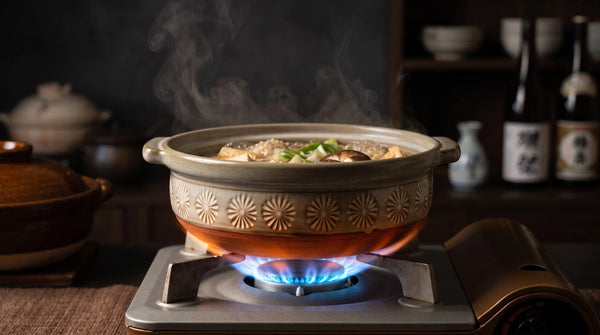
Traditional donabe are sized in gō (号), a traditional marker based roughly on the pot's diameter rather than a fixed capacity, so the same gō can vary in real size between makers and shapes. As a rough guide for the pots in our own range: a 7-gō suits about 1 to 2 people, an 8-gō about 3 to 4, and a 9-gō about 4 to 5. For a concrete sense of scale, our 8-gō rose donabe measures about 25 cm across and our 8-gō Banko daisy pot holds about 2.9 L. Check the listed diameter and capacity on a specific pot rather than the gō number alone, and buy for the group you usually feed, since a half-empty pot heats less evenly.

Stovetop matters more than people expect. Most traditional donabe are made for gas or open flame and are not induction-compatible unless the maker says otherwise. If you cook on an induction (IH) hob, you need a donabe built for it, such as our IH-compatible Ginpo donabe. Our other pots, including the Ginpo Hana-Mishima donabe and the larger 9-gō Yuzuriha sukiyaki pot, are made in the traditional way for gas and open flame.

Most of these are Banko ware (萬古焼) from Mie Prefecture, the region that makes the majority of Japan's donabe because its clay stands up to direct, repeated heat. There is more on that tradition in our Banko ware guide.
What is a tonsui bowl?
A tonsui (呑水) is the small bowl with a lip on one side, made for eating at a hot pot. The lip, or thumb tab, gives you a place to hold the bowl and steady it while you move broth, vegetables, tofu, or dumplings out of the shared donabe. It is the single most useful bowl at a nabe table, and it doubles the rest of the year as a bowl for rice, salad, or dessert.

Our Ginpo Hana-Mishima tonsui is a 13 cm Banko earthenware bowl with stamped white-slip chrysanthemums in the mishima style, made by Ginpo Pottery (銀峯陶器) in Mie. You want one tonsui per guest, so plan the count around your table.
Renge and dipping dishes: the rest of the table
The renge (蓮華) is the ceramic spoon named for its lotus-petal shape. A good nabe renge has a hooked handle that rests on the pot's rim between servings. Our Hana-Mishima renge and rest set matches the donabe and tonsui, and its rest can also hold a little sauce. For a lighter porcelain option, the Kutani whale-tail renge works for ramen and hot pot alike.

For the sauces, a few small dishes keep ponzu and sesame separate. A set like our Mino ware kobachi, eight to a box, covers a full table and stores flat between uses.
Building a matched set
You can mix pieces freely, but a matched series pulls the table together. Ginpo's Hana-Mishima line runs across the donabe, the tonsui, and the renge in the same stamped-chrysanthemum pattern. One thing to note: the accessories use a slightly different clay body from the pot, so the tonsui and renge sit a shade lighter than the donabe. It reads as a set rather than an exact color match, which is normal for this series.
If you are starting from nothing, a workable first table is one donabe sized to your group, one tonsui and one renge per guest, and one set of small dishes for sauce. The pots live in the donabe and clay pots collection, and the bowls, spoons, and dishes in bowls, plates and spoons.
Before the first use
Many traditional donabe benefit from a first-use seasoning step (medome) before their first hot pot, though not all: some modern donabe are sold as no-seasoning-required, so check the instructions for your specific pot. Clay pots also want a different washing routine from porcelain. Rather than repeat it here, our donabe care guide walks through first-use care, daily cooking, and storage. The short version: follow the maker's first-use instructions, avoid thermal shock, and dry the pot fully before storing.

FAQ
What is a tonsui bowl used for?
A tonsui is a lipped side bowl used at a Japanese hot pot. The thumb lip lets you hold and steady the bowl while transferring broth, vegetables, tofu, or dumplings out of the shared donabe. Each guest uses their own. Outside hot pot season it works as a small bowl for rice, salad, or dessert.
How many people does a donabe serve?
Donabe are sized in gō, a marker based roughly on diameter rather than a fixed capacity, so the same gō can differ between makers. As a rough guide for the pots in our range, a 7-gō suits about 1 to 2 people, an 8-gō about 3 to 4, and a 9-gō about 4 to 5. Check the listed diameter and capacity on the specific pot rather than the gō number alone.
Do all new donabe need seasoning?
No. Many traditional donabe benefit from a first-use seasoning step called medome, often simmering a starchy liquid such as thin rice porridge to seal the clay. But some modern donabe are sold as no-seasoning-required, so always check the maker's instructions for your specific pot before the first use.
Can you use a donabe on an induction (IH) stove?
Only if it is made for induction. Most traditional donabe are built for gas or open flame and will not work on an IH hob unless the maker states IH compatibility. If you cook on induction, choose a donabe specifically labeled IH-compatible.
What is the difference between a tonsui and a renge?
A tonsui is the lipped side bowl you eat from at a hot pot; a renge is the ceramic spoon for broth, named for its lotus-petal shape. A full per-person setting uses both: a tonsui to hold your food and a renge for the soup.
What sauces go with Japanese hot pot?
The two most common are ponzu, a citrus soy sauce, and goma, a sesame sauce. They are served in small individual dishes so each guest can dip from the shared pot. Keeping a few small kobachi dishes on the table lets everyone have their own sauce.
ZenKiln sources these Banko and Kutani pieces and ships them from Japan; they are packed for dispatch from our studio in Yoyogi, Tokyo. Sizing, capacity, and fit above come from our supplier records; see each product page for specifics.